


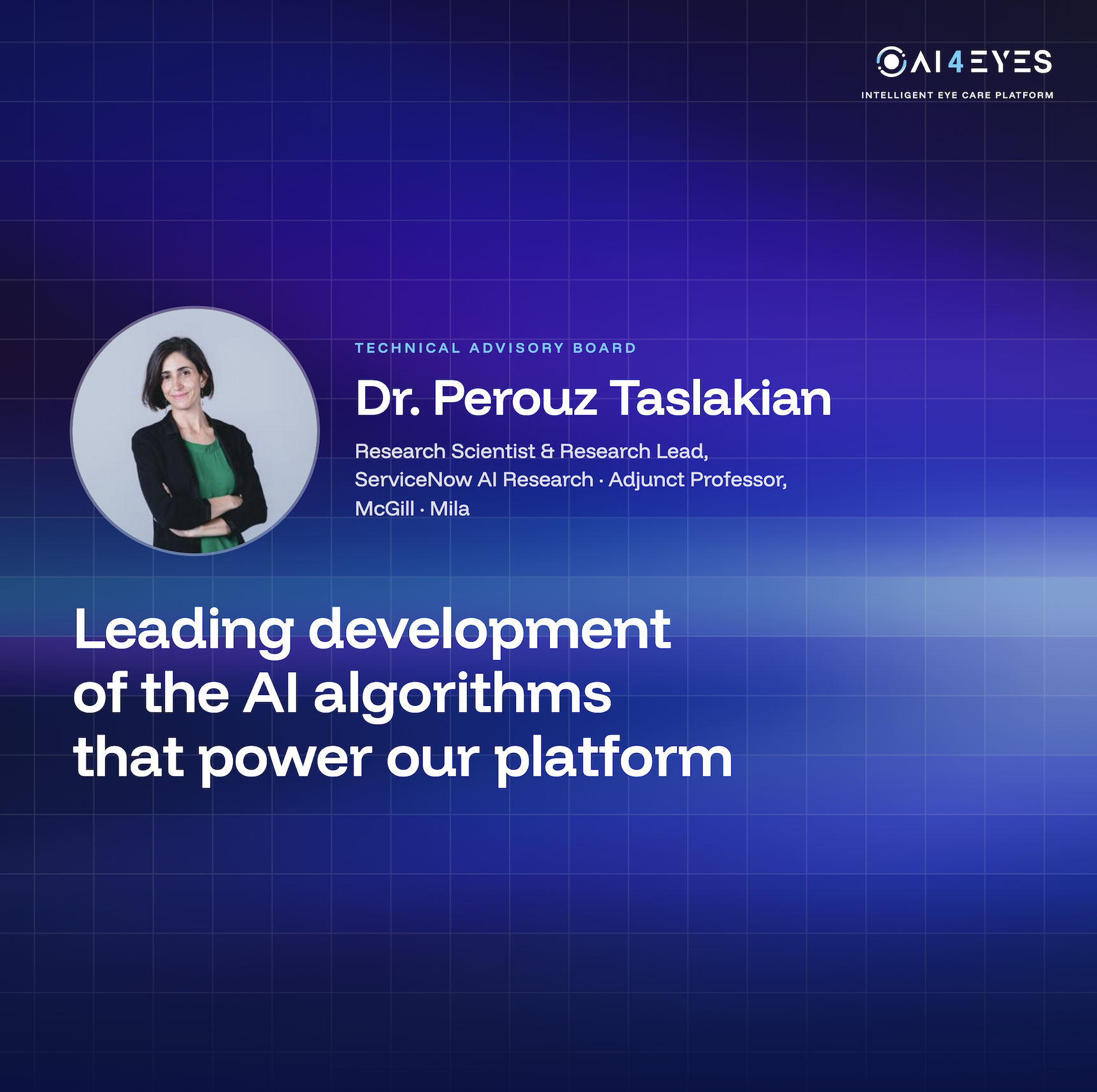
At AI4Eyes, we're proud to have Dr. Perouz Taslakian leading development of our AI algorithms as part of our Technical Advisory Board. Perouz works closely with our team as well as her student Masoumeh Sharafi to build the intelligence that powers our platform.
A Researcher at the Frontier of Multimodal AI
Perouz brings world-class expertise in machine learning to AI4Eyes. She is a Research Scientist and Research Lead at ServiceNow AI Research, and holds appointments as an Adjunct Professor at McGill University and an Associate Industry Member at Mila – Quebec AI Institute. She leads the Adaptive Agents research team and previously led ServiceNow's Multimodal Foundation Models program. Her work on vision–language models, particularly reasoning over charts and diagrams, has equipped her to build AI systems that make sense of complex, real-world data, including clinical images and videos. Prior to joining ServiceNow, she held research positions at Samsung AI Center and Element AI. She earned her Ph.D. in Computer Science from McGill University.
We're fortunate to have that caliber of expertise shaping how our algorithms learn.
Built on Data You Can Trust
Great AI starts with great data. Every image and video in our dataset is annotated and validated by experts, so our algorithms learn from inputs that are accurate and clinically meaningful.
Our datasets are engineered to minimize bias and overfitting through:
- High-quality clinical imaging and video capture
- Expert-led annotation and review
- Proprietary ground-truth data collected directly in clinical settings; not scraped from the web
- Enough volume and diversity to reflect real clinical variability
The result: AI that delivers reliable, consistent suggestions for diagnosis and treatment, while staying transparent and clinically interpretable.
AI That Empowers Clinicians: Not Replaces Them
The algorithms Dr. Taslakian helps develop are built as clinical decision-support tools, not clinician replacements. They integrate multiple diagnostic inputs, track subtle changes over time, and surface patterns that can be easy to miss in a routine exam, all grounded in her research on modeling relationships across complex, multimodal data.
The goal is simple: better consistency, better longitudinal care, and clearer conversations with patients. The clinician always has the final word.
Starting Where It Matters Most: Dry Eye Disease
We're focusing our algorithm development on Dry Eye Disease: one of the most common, and most overlooked, conditions in eye care.
- ~50% of patients are affected, yet only ~8% are formally diagnosed
- Two-thirds of patients show no symptoms
- Prevalence climbs to ~75% in people over 65
- It's also common among younger populations, including university students
- It disrupts everyday life: driving, reading, screen time
It's a condition that's everywhere, hard to catch consistently, and a perfect match for AI-supported assessment.
Built to Scale Beyond Dry Eye
Dry Eye Disease is our starting point, not our ceiling. The data infrastructure Dr. Taslakian is building is designed to expand into other ocular surface diseases.
A True Team Effort
Dr. Taslakian works hand-in-hand with our Medical Advisory Board and Head of Medical Affairs, keeping technical development and clinical practice tightly aligned every step of the way.